.jpg)
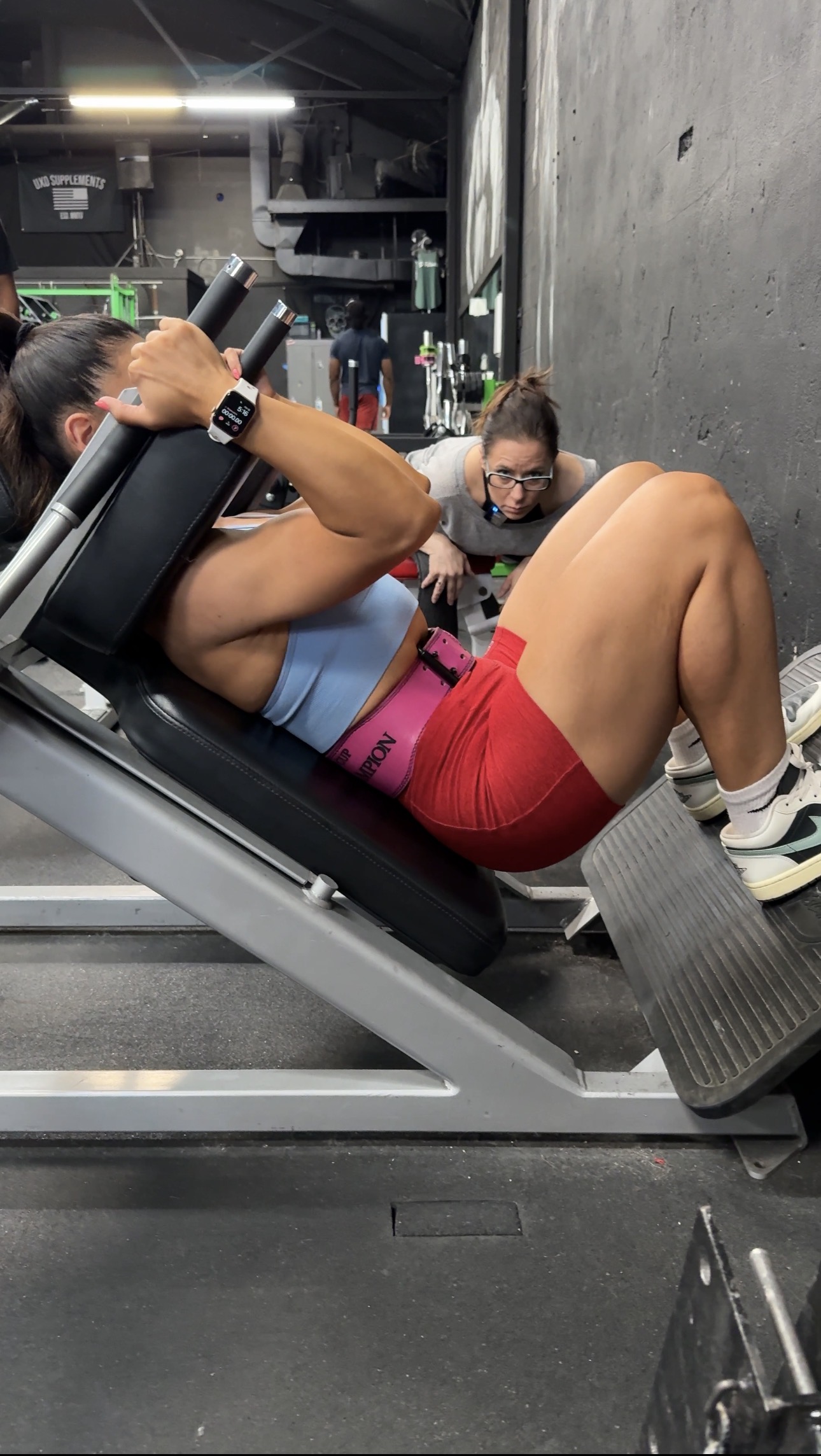
Offseason weight gain for Bikini competitors isn't really about a specific number. It's about whether the weight you're gaining is building the physique you're trying to bring to stage. Here's how to tell the difference between a productive building phase and one that just makes the next prep harder.
This is one of the questions that creates the most anxiety in Bikini, and it is also one of the questions that gets the most confidently wrong answers online. Search for it and you will find a range that makes the whole thing feel impossible to sort out. Some sources say five to ten pounds above stage weight is plenty. Others describe competitors walking around 20 or 25 pounds above their competition weight and calling it a productive building phase. Neither of those answers is wrong in every case, and both of them are wrong in most cases, which is the kind of non-answer that does not help anyone actually trying to plan her offseason.
The more useful question is not how much weight you should gain. It is what you are trying to accomplish in the offseason, and whether the weight you are gaining is moving you toward that goal or away from it. When you frame it that way, the number stops being the point.
What the Offseason Is Actually For
A lot of Bikini competitors spend their offseason trying to stay as close to stage condition as possible because the idea of being further from that look feels like going backward. This is one of the most common and most costly mistakes in this sport, and it quietly limits every prep that follows.
The offseason is not a holding pattern. It is the phase where the actual work of building the physique happens. The muscle that makes a Bikini athlete competitive, the shape in the shoulders, the fullness through the glutes, the development in the legs that creates proportion, none of that gets built during prep. Prep reveals what is already there. The offseason is where it gets built. An athlete who spends every offseason at near-stage weight, keeping calories low and cardio high to avoid gaining, is not maintaining her physique. She is slowly limiting its ceiling.
Building muscle requires a caloric environment that supports it. Not a dramatic surplus, not eating without any awareness, but enough fuel coming in that the body has the raw material to add tissue over time. That environment is, by definition, an environment where some body fat will also accumulate. That is not a flaw in the process. That is how the process works. An athlete who is not willing to carry any additional body fat in the offseason is an athlete who is not going to meaningfully develop her physique between shows. That is just the reality of it.
Productive Gain Versus Unnecessary Gain
The distinction that matters is not a specific number on the scale. It is the difference between weight that is moving the physique forward and weight that is just adding body fat without any corresponding muscle development to show for it.
Productive offseason gain looks like a moderate caloric surplus combined with serious, progressive training, gaining at a rate slow enough that most of what is being added is actually muscle tissue. The scale will go up. The athlete will carry more body fat than she did on stage. But her training performance will improve, her muscle fullness will be visible, and when she eventually starts prep she will have more to work with than she did the last time.
Unnecessary gain looks like eating without structure because the comp diet was so restrictive that the rebound felt justified, not training with the kind of intensity that actually drives muscle development, and gaining mostly body fat over months without the muscle to accompany it. The scale went up the same amount, or more, but prep will now need to be longer and more aggressive to get back to stage condition, and the physique underneath the body fat is not significantly better than it was before.
The problem is that both of those scenarios can produce the same scale weight. Fifteen pounds above stage weight can represent a great offseason or a wasted one depending entirely on what actually happened to the body during that time.
Why Stage Weight Is a Poor Reference Point
Most competitors use their stage weight as the anchor for offseason weight gain calculations, which makes intuitive sense but has a real flaw built into it. Stage weight is not a healthy, sustainable body composition. It is the lowest functional body fat level an athlete can hit while still presenting well on stage, maintained for a period of days. Using it as the starting point for "how much can I gain" builds the calculation on a number that was never meant to be a baseline.
A healthier reference point is what we call a comfortable walking-around weight, the weight at which you are eating well, training hard, sleeping, and functioning like an actual human being without chronic restriction. For most Bikini competitors this sits somewhere between 8 and 15 pounds above their stage weight, though that range is wide because athletes vary significantly in their natural body composition and muscle mass. From that walking-around weight, a productive offseason might add another 5 to 10 pounds over the course of a genuine building phase, most of it muscle with some body fat.
When you work the math from there instead of from stage weight, the total number above stage weight can look higher than what most articles suggest. An athlete who stages at 125 pounds, walks around comfortably at 135, and gains another 8 pounds in a productive building phase is sitting at 143. That is 18 pounds above stage weight, and it represents a well-managed offseason. That same athlete at 143 because she ate without structure and barely trained is a completely different situation with a much harder road back.
What Too Much Looks Like
There is a version of offseason gain that genuinely does make the next prep harder, longer, and more costly in terms of muscle loss, and it is worth being honest about where that line is.
When the rate of gain is fast enough that the body is primarily adding body fat rather than muscle tissue, something in the range of more than a pound or so per week for an extended period, the surplus has gone beyond what muscle development can productively use. The body takes that excess energy and stores it, and it has to come back off during prep under conditions that are already challenging for muscle retention. A very aggressive offseason that added significant body fat means a longer prep at a steeper deficit, which almost always costs more muscle than a more conservative approach would have.
The other sign that gain has gone further than it needs to is prep timeline creep. If you need more than 20 weeks to get from your current offseason weight back to stage condition, and you are doing that every single prep cycle, something in how you are managing the offseason is not working. Prep should not require months of suffering just to undo the previous offseason. That cycle is hard on the metabolism, hard on the muscle, and hard on the mental relationship with food and your own body.
The Athlete Who Never Actually Builds
There is a specific pattern that shows up in Bikini competitors who have been competing for several years without meaningful improvement, and it almost always traces back to this. She preps hard, she gets to stage condition, she places somewhere in the middle of the lineup, she takes a short offseason that never really gets far from stage lean, and then she preps again. She is working hard. She is consistent. But the physique she is bringing to shows is not meaningfully different from the one she brought two years ago, because the phase where actual development happens is not happening.
Building a Bikini physique that moves up in competitive placings over time requires real offseason phases. Phases where calories are genuinely supportive of muscle building, where training is progressive and focused on development, where you are willing to carry more body fat than is comfortable because you understand that discomfort is part of what creates the physique you are working toward. The competitors who improve the most between shows are almost always the ones who took the offseason seriously rather than spending it trying to stay close to stage weight.
How to Actually Approach the Number
Rather than asking how much weight you should gain, the more productive questions are: are you eating enough to support muscle development, are you training in a way that actually drives it, and are you gaining at a rate that suggests you are primarily adding muscle rather than primarily adding fat?
If calories are moderate and progressive, training is serious and consistent, and the rate of gain is somewhere around half a pound to a pound per week or slower, the offseason is probably working. If the scale is moving faster than that, or training has not been the priority it should be, the gain is more likely fat than muscle, and the next prep will reflect that.
The offseason is not a break from competing. It is the prep for the next prep. Most of the Bikini athletes who plateau between shows are not lacking discipline. They are lacking a clear plan for what the offseason is supposed to accomplish and how to structure it so the next prep actually has something better to work with. That is not a willpower problem. It is a groundwork problem, and it starts here.
If you're preparing for a show and want your cardio, nutrition, and training programmed by coaches who understand the actual physiology behind what works, our team at USA Physique would be glad to take a look at where you are and what you need. Fill out a coaching application and let's talk about what your prep should actually look like.